Showing posts with label facebook. Show all posts

Tuesday, March 8, 2016

Bengaluru-based hacker Anand Prakash finds bug in Facebook login system; rewarded $15000

Bengaluru-based hacker Anand Prakash finds bug in Facebook login system; rewarded $15000

Bengaluru-based Anand Prakash found a vulnerability on Facebook which could have been used to hack into any user account easily without any user interaction. This could give full access to view messages, credit/debit cards stored under payment section, personal photos and much more.

According to a post on Prakash’s blog, he stated that, “Whenever a user forgets his password on Facebook, he has an option to reset the password by entering his phone number/email address and Facebook will then send a 6 digit code on his phone number/email address, which can be used in order to set a new password.” He added that he tried to brute the 6 digit code on Facebook and was blocked after 10-12 invalid attempts.


Prakash looked out for the same issue on beta.facebook.com and mbasic.beta.facebook.com and found that rate limiting was missing on ‘forgot password’ endpoints. He tried to takeover his own account and was successful in setting new password for it as well. With this method, he could then use the same password to login in the account.

Facebook, on its part, acknowledged the issue promptly and fixed it. The hacker was rewarded $15,000 (approximately Rs 10 lakh) considering the severity and impact of the vulnerability.

Read More

Wednesday, June 18, 2014

Facebook launches mobile app that does not require Facebook account

Facebook Inc launched a smartphone app on Tuesday that will allow consumers to exchange disappearing photos and videos without requiring Facebook accounts, the Internet Company's latest effort to develop mobile services beyond its core social network.

The new app, dubbed Slingshot, allows users to sign up for the service with their mobile phone number and connect with friends in their phone's contact list or, if they want, by finding their Facebook friends.

Photos on Slingshot disappear from users' phones shortly after they are viewed, reflecting a growing anxiety about privacy in the age of Internet social networking.

Facebook's release of Slingshot comes as a new crop of mobile messaging services gain popularity and threatens to draw younger users away from Facebook's 1.28 billion-user social network.

To help mitigate the threat from alternative social networks, Facebook is developing a variety of standalone apps and acquiring fast-growing rivals. In 2012 it acquired photo-sharing service Instagram and in February it announced plans to acquire messaging app WhatsApp for $19 billion.

Snapchat, an app that lets users send messages that automatically disappear after a few seconds, turned down a $3 billion acquisition offer from Facebook last year, according to media reports at the time.

Unlike other messaging apps, Slingshot will not allow users to view the messages they have received from their friends until they reciprocate and send back a photo or video of their own. The rule is designed to make Slingshot a service for which everyone contributes material, although it could require a learning curve that confuses or turns off some users.

"When everyone participates there's less pressure, more creativity and even the little things in life can turn into awesome shared experiences," Facebook said in a blog post announcing the service on Tuesday.

Slingshot will be available in the United States on Tuesday for Android and iOS devices.
Read More

Thursday, June 12, 2014

Five Labs analyzes your Facebook posts to supposedly reveal your personality


A lot of people addicted to social media judge people on the basis of the posts and photos they upload, or the comments they like. There are certain posts and comments that are taken far too seriously, but what if these were indicators of how the person is in real life?

A company called Five Labs has created a tool that claims to reveal an individual’s personality via their social media uploads. This tool analyses the News Feed of your Facebook account and gives a thorough analysis of your personality. The tool is based on a study conducted in the University of Pennsylvania that looks at the five biggest personality traits that can be used to narrow down the actual personality of the person. These are include extroversion, openness, neuroticism, conscientiousness and agreeableness.

As the tool is free, anyone can give it a try. We think the results should not be taken at face value since many of our posts and shares may have nothing to do with us or our opinions. They could be favours for friends, for example, but there’s no way the tool would know that, if your interaction with that person is not limited to just that one post.

On conducting the analysis of the app I found it quite hard to believe that I scored the highest in neuroticism with 53 percent. I scored 49 percent for openness, 13 percent for extroversion, 34 percent for agreeableness and 24 percent for conscientiousness. While I don’t quite agree with the neuroticism score, every other score seems fair.

Compare

The tool also allowed me to compare my scores with famous public figures and my Facebook friends. On comparision with Bill Gates scores I found out that 51 percent of our personality traits are similar through our Facebook posts. Unfortunately, that’s the only things in common between us.

There’s just one hitch that we just haven’t been able to understand, the tool lets you compare your score to Mahatma Gandhi as well. We are pretty sure the great man is not a part of Facebook. We’ve reached out to Five Labs for a clarification.
Read More

Wednesday, June 4, 2014

Facebook buys Pryte, a mobile data plan firm


Facebook is acquiring Pryte, a Finnish company that aims to make it easier for mobile phone users in under-developed parts of the world to use wireless Internet apps.

Facebook did not disclose financial terms of the deal, which spokeswoman Vanessa Chan said is expected to close later this month.

Pryte’s service, which has not publicly launched yet, seeks to make it easier for consumers without wireless data plans to use online services by selling short-term passes that would provide access to particular mobile apps, such as Facebook or Foursquare.

Facebook, the world’s largest social network with 1.28 billion users, is primarily interested in the team behind Pryte, led by Chief Executive Markku Makelainen, Chan said.

The one-year old, Helsinki-based company has valuable experience and relationships working with wireless operators, particularly in emerging markets, she said.

The company has fewer than 30 employees, though it’s not clear how many will join Facebook.

The deal marks Facebook’s latest effort to advance its mission of connecting people in under-developed parts of the world to the Internet. Facebook has partnered with wireless operators in certain countries to offer free access to its social network and the company is building drones and satellites that will beam Internet access to remote regions of the world.

Facebook Chief Executive Mark Zuckerberg has said that connecting the “next five billion people” to the Internet is one of the company’s top priorities going forward.
Read More

Thursday, May 29, 2014

Iranian hackers use fake Facebook accounts to spy on US and other countries

In an unprecedented, three-year cyber espionage campaign, Iranian hackers created false social networking accounts and a fake news website to spy on military and political leaders in the United States, Israel and other countries, a cyber intelligence firm said on Thursday.

ISight Partners, which uncovered the operation, said the hackers’ targets include a four-star U.S. Navy admiral, U.S. lawmakers and ambassadors, members of the U.S.-Israeli lobby, and personnel from Britain, Saudi Arabia, Syria, Iraq and Afghanistan.

The firm declined to identify the victims and said it could not say what data had been stolen by the hackers, who were seeking credentials to access government and corporate networks, as well as infect machines with malicious software.

“If it’s been going on for so long, clearly they have had success,” iSight Executive Vice President Tiffany Jones told Reuters. The privately held company is based in Dallas, Texas and provides intelligence on cyber threats.

ISight dubbed the operation “Newscaster” because it said the Iranian hackers created six “personas” who appeared to work for a fake news site, NewsOnAir.org, which used content from the Associated Press, BBC, Reuters and other media outlets. The hackers created another eight personas who purported to work for defense contractors and other organizations, iSight said.

The hackers set up false accounts on Facebook and other online social networks for these 14 personas, populated their profiles with fictitious personal content, and then tried to befriend target victims, according to iSight.

The operation has been active since at least 2011, iSight said, noting that it was the most elaborate cyber espionage campaign using “social engineering” that has been uncovered to date from any nation.

To build credibility, the hackers would approach high-value targets by first establishing ties with the victims’ friends, classmates, colleagues, relatives and other connections over social networks run by Facebook, Google and its YouTube, LinkedIn and Twitter.

The hackers would initially send the targets content that was not malicious, such as links to news articles on NewsOnAir.org, in a bid to establish trust. Then they would send links that infected PCs with malicious software, or direct targets to web portals that ask for network log-in credentials, iSight said.

The hackers used the 14 personas to make connections with more than 2,000 people, the firm said, adding that it believed the group ultimately targeted several hundred individuals.

“This campaign is not loud. It is low and slow,” said Jones. “They want to be stealth. They want to be under the radar.”

ISight said it had alerted some victims and social networking sites as well as the U.S. Federal Bureau of Investigation and overseas authorities. An FBI spokeswoman declined to comment.

Facebook spokesman Jay Nancarrow said his company had discovered the hacking group while investigating suspicious friend requests and other activity on its website.

“We removed all of the offending profiles we found to be associated with the fake NewsOnAir organization and we have used this case to further refine our systems that catch fake accounts at various points of interaction on the site and block malware from spreading,” Nancarrow said.

LinkedIn spokesman Doug Madey said the site was investigating the report, though none of the 14 fake profiles uncovered by iSight were currently active.

Twitter declined to comment and Google could not immediately be reached for comment.

POST-STUXNET ERA

ISight disclosed its findings as evidence emerges that Iranian hacking groups are becoming increasingly aggressive.

Cybersecurity company FireEye reported earlier this month that a group known as the Ajax Security Team has become the first Iranian hacking group to use custom-built malicious software for espionage.

Iranian hackers stepped up their activity in the wake of the Stuxnet attack on Tehran’s nuclear program in 2010. The Stuxnet computer virus is widely believed to have been launched by the United States and Israel.

ISight said it could not ascertain whether the hackers were tied to the government in Tehran, though it believed they were supported by a nation state because of the complexity of the operation.

The firm said NewsOnAir.org was registered in Tehran and likely hosted by an Iranian provider. The Persian term “Parastoo” was used as a password for malware associated with the group, which appeared to work during business hours in Tehran, according to iSight.

Among the 14 false personas were reporters for NewsOnAir, including one with the same name as a Reuters journalist in Washington; six employees who purportedly worked for defense contractors; a systems administrator with the U.S. Navy; and an accountant working for a payment processor.
Read More

Monday, May 19, 2014

Facebook reportedly working on Slingshot, a Snapchat rival


Facebook is developing its own video-chat app, known internally as Slingshot, after its failed attempt to acquire mobile messaging startup Snapchat, the Financial Times reported on Sunday.

Facebook has been working for several months on the planned video-chat app, which would allow users to send short video messages using a touch-screen, the FT said, citing people familiar with its plans.

Slingshot could be launched this month, the paper cited one source as saying, while noting that Facebook might ultimately decide not to proceed with the launch of the app.

Facebook chief Mark Zuckerberg has been overseeing the “top-secret” project after the social network company was unable to win Snapchat’s creators, Evan Spiegel and Bobby Murphy, with its $3 billion takeover offer late last year, the FT said.

Snapchat, popular among teenagers, allows users to send smartphone photos that automatically disappear after a few seconds.
Read More

Saturday, May 3, 2014

Jury asks Samsung to pay Apple $120 million: Here’s why it’s bad news for Apple


The jury deliberation from the latest round in the seemingly neverending Apple vs Samsung battle is over and the verdict is in. After over a month of speculation, Samsung has been ordered by the jury to pay $119.6 million to Apple for infringing on patents.

But while on the face of it, it seems like a win for Apple, it must be remembered that the Cupertino company had been seeking damages in excess of $2 billion for the same infringements. It’s a big blow to Apple’s patent litigation strategy and the jury-awarded damages seems like pocket change in comparison to the $2 billion.

Much of the $119.2 million would have been spent by Apple towards forming their case. No doubt the countless hours spent with patent experts and the manpower needed to gather expert testimony to bolster their case would have resulted in considerable expenses.

Critics of Apple’s patent litigation strategy would be quietly smiling to themselves. For them the verdict vindicates Apple’s ‘wrong’ approach. It’s clear that Apple has waged a proxy war against Android in general with its many high-profile court cases against Samsung. After all in many markets, Samsung is analogous to Android, and is without doubt the biggest OEM backing the platform. Android’s growth is directly as a result of Samsung’s all-out assault on the market, with its Galaxy S series of phones being the so-called crown jewels. So by seeking massive damages and also a sales injunction against Samsung phones, Apple is hoping to curtail Android’s growth in the high-end segment, to protect its revenue growth and market share. So the comparatively minor penalty will come as a big blow for Apple.

There still remains the question of whether Judge Lucy Koh will rule in favour of Apple in the matter of the injunction. The jury only decided the damage amount, while Koh reserves the verdict on an injunction. It looks highly unlikely, though, given the rather lenient jury verdict.
Read More

Facebook acquires Moves, a fitness tracking app


Social networking site Facebook has acquired Helsinki-based fitness tracking app Moves in an undisclosed deal.

“We are joining Facebook’s talented team to work on building and improving their products and services with a shared mission of supporting simple, efficient tools for more than a billion people,” a statement from the firm read.

Earlier this year, Facebook bought mobile messenger WhatsApp for $19 billion and Oculus VR for $2 billion.

Facebook has confirmed to the Wall Street Journal (WSJ) that the Moves deal is “nowhere near the size of other acquisitions the company has made in recent months”.

According to the Moves developer ProtoGeo, the application has been downloaded four million times for iPhone and Android phones since its launch in January 2013.

Moves continues to operate separately from Facebook.
Read More

Tuesday, April 29, 2014

Now shoot and send pictures instantly with Facebook Messenger for iOS and Android


Facebook has rolled out updates to its Messenger app on iOS and Android. The latest update enables users to take a photo while chatting instantly and send it through to any contact.

The company claims that the messenger now has improved search capability that will ensure a user can quickly find a contact or group of people. Users can also record a video or take a photo and instantly send it. They can preview the photo or a video in the camera roll before sending it.

Another feature Facebook has rolled out is about stickers used during conversations. If a person receives a sticker while conversing with another individual, then the receiver can just press and hold down the sticker to download the entire sticker pack.

The new update to Facebook messenger lets users watch a video or listen to a sound file they receive by simply tapping on it within the app itself without any need to leave the app.

The update is live for iOS and Android will eventually receive these updates this week. Apart from iOS and Android, Messenger is also available for Windows Phone, but the latest updates are not available on it.
Read More

Friday, April 18, 2014

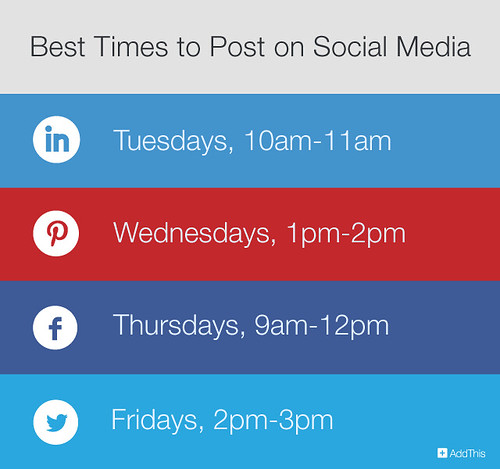
When’s the Best Day and Time to Post on Social Media?

It’s the age-old social media and content marketing question: when’s the best time to post on social media?

best-time-to-post-on-social-media-addthis


Your social analytics can give you an indication of when your audience is engaging with your content, and there are tons of blog posts out there offering you sound advice on when you should post your content on social media. But it’s not enough to just know when your visitors are online, but when they’re engaging online (i.e. clicking, sharing, emailing, and even printing).

We took a look at our proprietary data based on 14 million sites using our tools worldwide (that’s about 3 billion pageviews a day), to help you optimize when you should post your content, including the day, time, and social network. Here’s what we found for Facebook, Twitter, LinkedIn, and Pinterest.

Facebook, Twitter in the daytime. Pinterest in the evening.

First, we looked at clicks and shares to see when users are consistently engaging with content the most during an average week. Keep in mind that all times are Eastern Time.

Facebook Twitter LinkedIn Pinterest
Shares       9am-11am,12pm    10am-12pm   10am, 2pm   3pm, 8pm
Clicks          3pm-5pm     3pm-5pm    1pm-2pm   8pm-10pm

Most sharing to Facebook, Twitter, and LinkedIn happens in the morning, when people get to work. Consequently, clicking (which is different from sharing) tends to dominate Facebook, Twitter, and LinkedIn in the afternoon hours. Pinterest users have the most activity in the evening hours when readers both share and click content as they’re winding down after work.

Tip: So, if you’re looking to increase clicks on your company’s social channels, try posting your content in the afternoons. instead of the mornings

Aim for the peaks every week.

We also looked at the peak of the week to see what day and time had content engagement spikes in an average week.
Facebook    Twitter    LinkedIn    Pinterest
Clicks & Shares Thursdays,
9am-12pm
    Fridays,
   2pm-3pm
    Tuesdays,
   10am-11am
      Wednesdays,
        1pm-2pm

It’s interesting to see that each social network has a different peak day and time; not everyone engages with all social networks at the same time. Common sense if you think about it.

Tip: If you’re posing your content across social networks, maximize engagement by posting on the peak day and time of those networks.

As much as data can be useful, don’t forget to think about the human aspect of sharing. Think about your own behaviors and habits on social networks. When are you most likely to share content and using what social media network? When do you have breaks at work? What social network do you find yourself scrolling through when watching TV at night? Chances are, your audience’s behaviors may not be that far off from yours.
Read More

Wednesday, April 16, 2014

Google buys Titan Aerospace to bring Internet through solar-powered drones


Looks like Facebook’s plans to get Internet-delivering drones on board has come up against a slight obstacle: Google.

Google has beaten the world’s largest social network to purchase solar-powered drone maker Titan Aerospace as the search giant ramps up plans to deliver wireless Internet access to remote parts of the world. Facebook was also reportedly in talks with the company, but Google has pipped it to the finish line.

Facebook has been known to be working on drone-enabled Internet delivery as revealed by Mark Zuckerberg last month. But Google is in a way a pioneer in this field with its Project Loon already underway in parts of the world.

Last year, Google had acquired Boston Dynamics, known for building robots that look as if they belong in a science-fiction movie. Big Dog, a four-legged robot that can climb muddy hills, and Cheetah, a robot which can outrun the fastest human, are among the robots that now belong to Google.

Titan Chief Executive Vern Raburn declined to provide information on the price of the deal, which he said closed on Monday morning. The 20-person company will remain in New Mexico for the foreseeable future, Raburn said, with all employees joining Google. The deal could further Google’s efforts to deliver Internet access to remote regions of the world. Last year Google launched a small network of balloons designed to deliver Internet access over the Southern Hemisphere, dubbed as Project Loon.

“Atmospheric satellites could help bring internet access to millions of people, and help solve other problems, including disaster relief and environmental damage like deforestation,” Google said in an emailed statement confirming the Titan acquisition.

Google’s acquisition of Titan comes several weeks after rival Facebook Inc announced plans to build solar-powered drones and satellites capable of beaming Internet access to underdeveloped parts of the world. A few weeks before Facebook’s announcement, press reports said that Facebook was in discussions to acquire Titan.

Titan is developing a variety of solar-powered “atmospheric satellites,” according to the company’s website, with initial commercial operations slated for 2015. The drones, which fly at an altitude of 65,000 feet and can remain aloft for up to five years and have a 165-foot (50-metre) wingspan, slightly shorter than that of a Boeing 777.

News of the acquisition was first reported on Monday by the Wall Street Journal.
Read More

Sunday, March 30, 2014

Facebook to use drones, satellites to provide Internet everywhere

Facebook Inc is harnessing drone, satellite and other technology in an effort to spread Internet to under-developed regions. The social networking giant stated that it has hired aerospace and communications experts from NASA's Jet Propulsion Lab and its Ames Research Center for its new "Connectivity Lab" project.

Facebook had started Internet.org in partnership with some other companies, last year to spread the internet. The company is working experimenting with drones that are capable of beaming internet from the sky. The organization aims to bring down the cost of internet connectivity.

"In our effort to connect the whole world with Internet.org, we've been working on ways to beam internet to people from the sky," Zuckerberg wrote on Facebook.

"Our team has many of the world's leading experts in aerospace and communications technology, including from NASA's Jet Propulsion Lab and Ames Research Center. Today we are also bringing on key members of the team from Ascenta, a small UK-based company whose founders created early versions of Zephyr, which became the world's longest flying solar-powered unmanned aircraft. They will join our team working on connectivity aircraft."

The announcement comes a day after Facebook announced the acquisition of Oculus Rift, a company that specializes in virtual reality products for $ 2 Billion. Mark Zuckerberg, stated that it plans to use Oculus' technologies to expand in "communications, media and entertainment, education and other areas".

Last year Google announced plans to use solar-powered balloons to deliver Internet access to remote regions of the globe. Google's Project Loon, supported Internet-beaming antennas on top of giant helium balloons placed in the stratosphere, that can create a wireless network with 3G like speeds.


Read More

Facebook Messenger Upgrades With Group Creation & Message Forwarding

Facebook chatterers, check your iPhones, as the new version of Facebook Messenger is now available. This one is version 4.0 and comes with two nifty new features.

Only available for iOS at the moment, the new Facebook Messenger comes with the ability to easily create groups, as well as forwarding IMs to other people.

The groups feature is something which could be aimed at WhatsApp (owned by Facebook) as they have the same feature. You can group people together into one conversation, and you can all chat together at the same time. Perfect for work discussions with colleagues, and general hanging out with friends.

Be careful when constructing your groups though, as each person in the group is instantly notified that they have been added. So don’t make any groups called “people I really hate”. Because then they will be told, and well….you’d better have a good explanation ready.

2014 03 28 18.59.14 333x500   Facebook Messenger Upgrades With Group Creation & Message Forwarding

Message forwarding is also a cinch. Simply keep your finger pressed down on the section of the message that you want to forward to another Facebook contact. It will then come up with three options, one of which is “forward”.

messengerfwd   Facebook Messenger Upgrades With Group Creation & Message Forwarding

Pressing “forward” will then bring up other Facebook contacts. Simply choose which lucky person gets the message, and it will be sent.

The new version also has the usual kaboodle of bug squashes and speed boosts, which are not totally exciting. Not when you are constructing groups and forwarding your one-liners.

Let us know in the comments what you think of the groups function being added. Do you think this is an attempt to undercut WhatsApp?
Read More

Wednesday, March 26, 2014

Facebook buys Oculus, a virtual reality glasses firm for $2 bn

Facebook buys Oculus, a virtual reality glasses firm for $2 bn

Facebook Inc will acquire two-year-old Oculus VR Inc, a maker of virtual-reality glasses for gaming, for $2 billion, buying its way into the fast-growing wearable devices arena with its first-ever hardware deal.

The acquisition, which comes hot on the heels of its $19 billion deal for messaging service WhatsApp, marks a big bet by Facebook to anticipate the next shift in an evolving technology industry, at a time when consumers are increasingly abandoning their PCs for smartphones.

The world’s largest social network was deemed late to recognize the shift to mobile devices and the company’s revenue has only recently begun to recover from the late start.

Many in the industry believe that wearable devices could represent the next big platform shift. Google Inc has been testing Google Glass, a stamp-sized electronic screen mounted to a pair of eyeglasses for several years. Last week, it introduced an effort to develop computerized wristwatches.

On Tuesday, Facebook said virtual-reality technology could emerge as the next social and communications platform.

“The history of our industry is that every 10 or 15 years there’s a new major computing platform, whether it’s the PC, the Web or now mobile,” Facebook co-founder and Chief Executive Mark Zuckerberg said in a conference call with analysts and media on Tuesday to discuss the acquisition.

“We’re making a long-term bet that immersive, virtual and augmented reality will become a part of people’s daily life,” the 29-year-old Zuckerberg said, noting that wearing the Oculus goggles was “different than anything I’ve ever experienced in my life.”

Zuckerberg said Facebook was not interested in becoming a hardware company and did not intend to try to make a profit from sales of the devices over the long term. Instead, he said Facebook’s software and services would continue to serve as the company’s underlying business, potentially generating revenue on Oculus devices through everything from advertising to sales of virtual goods.

While Oculus will operate as an independent company, Zuckerberg stressed that Facebook’s plans for Oculus extended well beyond games.

“Imagine enjoying a court side seat at a game, studying in a classroom of students and teachers all over the world or consulting with a doctor face-to-face – just by putting on goggles in your home,” he said.

In addition to game makers, Oculus has garnered some interest from developers keen on creating apps in areas like architecture, automobiles, marketing and education, the company has said.

Shares of Facebook, which have risen 25 percent in the past six months, were down nearly 1 percent at $64.36 in late trading on Tuesday.

Facebook’s recent spate of acquisitions is somewhat concerning, RBC Capital Markets analyst Mark Mahaney wrote in a note to investors on Tuesday. But he said that for a company of Facebook’s size, the deal did not seem “irrational.”

“The question this time is whether Facebook is too early or simply betting on the wrong platform. This won’t be known for some time. But if it gets the platform right, we’re relatively confident that Facebook will develop an effective monetization strategy for it, thus boosting its overall financial growth,” Mahaney said.

HAPPY, GO LUCKEY

The acquisition makes Oculus VR one of the most successful companies or projects to ever emerge from the fledgling Kickstarter program, which has helped attract small investments from the public for everything from the Pebble smartwatch to the recent “Veronica Mars” movie.

Oculus VR, founded by Palmer Luckey, a self-described virtual-reality enthusiast and hardware geek, got its start as a Kickstarter-funded program, drawing small investments from thousands of people on the popular fund-raising platform.

It quickly drew attention to its “Oculus Rift” virtual-reality glasses, demoed at tech and gaming conventions around the country.

Oculus VR raised $75 million in December in a round led by Andreessen Horowitz, to market its virtual-reality headset for video games and develop the product for use in areas like education, film, architecture and design. Andreessen Horowitz partner Marc Andreessen, who is also on Facebook’s board, said in a tweet on Tuesday that he was recused “on both sides” of the Facebook Oculus deal.

Other venture capital backers included Spark Capital, Formation 8 and Matrix Partners. Oculus now employs more than 100 people and has distributed some 75,000 software development kits for Oculus Rift to game developers and others.

It recently began taking orders for new software development kits with better graphics and features to reduce motion sickness – a frequent complaint of the old prototype – slated to ship in July for $350 apiece.

Oculus plans to produce commercial versions of its virtual-reality glasses, called Oculus Rift, which users mount on their heads with a strap. It also hopes to take its technology beyond gaming.

“Virtual reality creates a canvas that is much richer than anything we’ve seen in computing so far,” Antonio Rodriguez, Oculus board member and general partner at Matrix Partners said in an interview with Reuters on Tuesday.

He said virtual reality presents an opportunity to re-imagine various tasks and social interactions in areas like medicine and education.

So far, “people have done all sort of apps (outside gaming) like body switching apps, where two bodies are scanned and you can switch identities.

Last week, Sony unveiled a prototype for a new virtual-reality headset accessory for its Playstation 4 games console at the annual Game Developers Conference in San Francisco. The headset, still in development under the name “Project Morpheus”, is designed to provide an immersive experience for gamers and is poised to compete with Oculus’ Rift once both devices are on the market.

DEAL SPREE

The deal, which Facebook said is expected to close in the second quarter, marks the company’s second multi-billion dollar acquisition since mid-February. Zuckerberg said on the call the two deals involved “incredibly rare companies” and that Facebook was unlikely to continue making big acquisitions at a similar pace.

Facebook ended 2013 with $11.45 billion in cash and marketable securities. The company’s $19 billion acquisition of WhatsApp includes $4 billion in cash. The Oculus deal comprises $400 million in cash and 23.1 million shares of Facebook common stock.

Finance Chief David Ebersman said the price of the deal was based primarily on the gaming business, but that Facebook believed the technology could be worth “multiples” of the purchase price if Facebook succeeds in extending it into other areas such as entertainment and communications.
Read More

Sunday, March 23, 2014

Facebook introduces Hack, a new PHP-based programming language


It is called Hack but it has little to do with hacking. It is a new programming language designed by Facebook that lets programmers build complex websites and other software quickly and without many flaws.

“We can say with complete assurance that this has been as battle-tested as it can possibly be,” Bryan O’Sullivan, the Facebook engineer behind the language, said in a statement.

Experts say Hack is a new version of PHP – the language Facebook founder Mark Zuckerberg used when he started building Facebook.

Hack too runs on the Hip Hop Virtual Machine but it lets coders use both dynamic typing and static typing.

For the next decade, Zuckerberg and his rapidly growing company continued to build their site with PHP.

But as a PHP site grows, you need far more computer servers to run the thing than you would with other languages and it can be difficult to manage all your code and keep it free of bugs.

Hack makes it easier to manage code and eliminate errors.

It provides these benefits without slowing down the developer. Unlike other statically type languages, Hack can run without compiling.

“You edit a file and you reload a web page and you immediately get the feedback. You get both safety and speed,” O’Sullivan added.
Read More

Tuesday, March 11, 2014

If WhatsApp Is Worth $19B, Then WeChat’s Worth “At Least $60B”


Heads turned when Facebook forked out $19 billion for messaging service WhatsApp in February, and eyes popped when Facebook CEO Mark Zuckerberg said it was probably worth even more. Now, analysts over at CrĂ©dit Lyonnais Securities Asia have taken up the baton on outsized messaging app valuations: it says that WeChat, a Chinese competitor owned by Tencent, is worth “at least $60 billion,” because of the fact that it has more active revenues streams incorporated into its service than WhatsApp does.

CLSA ranges the valuation between $35 billion and $64 billion this year.

In a bullish research note published today on Tencent (subtitle: “Building an empire”), analysts Elinor Leung and Terry Chen make the case for how WeChat should be worth at least two to three times the value of WhatsApp, which they had previously valued at $35 billion. Although it looks like WeChat has less users — around 300 million today to WhatsApp’s 465 million — it has more revenue streams.
“WhatsApp only generates US$1/download,” they write. “WeChat could generate revenues from mobile games, advertising, eCommerce, O2O, mobile payment and Internet financing. Asia leads the global smartphone game market especially Korea, Japan and China. eCommerce, online to offline payments and mobile payment are unique business opportunities in China given the poor offline infrastructure. Tencent has also invested heavily and made aggressive acquisitions such as JD and Dianping to secure the business opportunities.”
It also believes that WeChat is likely to hit 450 million users this year, with each subscriber worth some $142.

WhatsApp has been careful in saying that it will continue to build its business under Facebook with the same revenue model in mind — no advertising, and users paying for the service itself. WeChat is not quite in the same boat but it too has taken an more delicate approach to advertising, for now at least.

“While most online and offline corporates are eager to tap WeChat users, Tencent has been careful controlling the promotional activities by its public accounts,” the CLSA analysts write. “Users can only find and follow the public accounts unless they know the name. Tencent doesn’t provide a list of public accounts for users. Tencent has also limited the daily promotional messages sent out by public accounts.”

However, CLSA goes on to note that Tencent “will likely turn more aggressive on monetizing through social advertising once user penetration is mature. Display ads may not be the best

advertising format on mobile social messaging platforms.”
Interestingly, other WeChat services not based on ads point to other areas where you could imagine WhatsApp (and Facebook) also potentially developing additional features. One specific area is payments.
Tencent has launched apps to such as red envelope (for “real money” P2P transfers) and taxi apps, which it is also integrating with WeChat. (Users provide bank, credit card or debit card account details to WeChat to register, and then enter a password and verification code (sent by Tencnet via SMS) to complete transactions for things like paying bills, buying things, red envelopes and subscriptions.
“WeChat payment registered users reportedly jumped 5 times given the viral effect of the red envelope app,” CLSA writes.

wechat payments

CLSA notes that its WeChat valuation is also based on a number of projections that point to already-large Tencent continuing to scale their business:
– by 2017 Tencent will take 40% of the mobile gaming market in the markets where it’s active and generate Rmb10bn ($1.6b) in earnings from mobile games;

– Tencent will take 10% of the B2C market and generate Rmb7bn ($1.1b) from eCommerce;

– Tencent will take 20% of payment market and generate Rmb3bn ($489m) from payments.

wechat tencent financial breakdown clsa

With that in mind, and considering WeChat’s role in facilitating that ecosystem, they forecast that by 2017 WeChat will be worth $92 billion, and contributing to a higher target for Tencent in general to HK$700/share (it closed trading today up slightly to HK$618).
Read More

Sunday, March 9, 2014

How To Find Out If Someone Unfriended You On Facebook


It's called "Unfriend Notify" and it works for Firefox and Chrome.
Here's how it works on Chrome. Get ready, it's incredibly simple.
Visit here and click Free. This will begin the extension download:

Then click Add.

Then you can visit Facebook. In your friends list, a new tab will appear called "Lost Friends." It will show you the people who have unfriended you since the last time you clicked the tab.
Read More

Privacy groups ask FTC to block Facebook-Whatsapp deal

facebook, ftc, acquisition, privacy, whatsapp, facebook-whatsapp

Last month, Facebook acquired the world’s most popular instant messaging service. And it seems not everyone is delighted with the move. Fearing that the social networking giant might use Whatsapp's user data for advertising purposes, two consumer privacy groups on Thursday filed a complaint with the Federal Trade Commission (FTC) stating that the deal may be an unfair trade practice, and should be blocked until there's a better understanding of how the company intends to use the personal data of millions of WhatsApp users.

Complaining parties, the Electronic Privacy and Information Center (EPIC) and the Center for Digital Democracy (CDD), claimed that Facebook has often changed its policies on collecting and sharing user data. For example, back in 2012, when Facebook acquired Instagram, it  amended the photo-sharing app's privacy policy.

Meanwhile, Facebook denies any such possibility. "As we have said repeatedly, Whatsapp will operate as a separate company and will honor its commitments to privacy and security," the company said in a statement in response to the filing. But the complainants are demanding more than just assurances. They want regulators to make sure that Facebook "insulates" WhatsApp user information from its data collection practices.

Facebook, which is the world's No.1 social networking website, generates the majority of its revenue through targeted advertisements. The company has a bad record of compromising users’ privacy, and has faced privacy complaints in the past. Back in 2011, the company was accused of using the names, photographs, and identities of users to advertise products without their permission.
Read More

Wednesday, March 5, 2014

WhatsApp creators Jan Koum and Brian Acton feature in Forbes’ latest list of billionaires

WhatsApp creators Jan Koum and Brian Acton feature in Forbes’ latest list of billionaires

Marking one of the biggest acquisitions so far, Facebook acquired WhatsApp for a whopping $19 billion last month. While we’ve been hearing the rags to riches tales around its creators Jan Koum and Brian Acton, here’s yet another feather in their cap. The duo has now secured a place in Forbes’ list of imminent billionaires.

While 38-year-old Koum takes the 202nd rank in the Forbes list, 42-year-old Acton takes the 551st spot. According to Forbes’ estimate, Koum holds about 45 percent stake in the company, while his co-founder Brian Acton’s stake is estimated at over 20 percent. That makes Koum worth $6.8 billion and Acton worth not less than $3 billion.

The duo are also known for their transformation from strugglers to billionaires. “37-year-old Jan Koum, born in the Ukraine, went to the US when he was 16-years-old. His family struggled living on food stamps, venture capitalist Jim Goetz revealed had said in a blog post. His house had no electricity or hot water. In fact, Koum’s family picked up their food stamps only a couple of blocks away from WhatsApp’s offices in Mountain View, California, said earlier report by Wired’s David Rowan.

Acton’s story shows us that persevering in spite of rejection worked miracles for him. In 2009, Facebook turned Acton down for a job. But Facebook wasn’t the only one to miss a golden opportunity, as Acton, who formerly worked at Yahoo, also appears to have been rejected by Twitter in 2009. Five years later, here they are.

In 2009, amidst the aftermath of the financial crisis, Koum and Brian Acton, longtime Yahoo employees, went on to create a messaging service that they hoped would become the biggest cross-platform in the world. Koum reportedly came up with the idea for his company in 2009 after his gym banned the use of cell phones.

Both are among the 26 new comers to join the list that also includes $3 billion worth Twitter’s Evan Williams. Bill Gates takes the top spot with a fortune worth $76 billion, but Facebook’s founder Mark Zuckerberg is said to have most money in the past year. The list also includes 42 women billionaires.
Read More

Yahoo will block Facebook, Google sign-ins for Fantasy Sports, Flickr and more

Yahoo will block Facebook, Google sign-ins for Fantasy Sports, Flickr and more

The change, which will be rolled out gradually according to a Yahoo spokeswoman, will require users to register for a Yahoo ID in order to use any of the Internet portal’s services. The move marks the latest change to Yahoo by Chief Executive Marissa Mayer, who is striving to spark fresh interest in the company’s Web products and to revive its stagnant revenue.

“Yahoo is continually working on improving the user experience,” the company said in a statement, noting that the new process “will allow us to offer the best personalised experience to everyone”.

The first Yahoo service to require the new sign-in process is Yahoo Sports Tourney Pick’Em, a service focused on the NCAA college basketball tournament which begins later this month. News of the change to Yahoo’s Tourney Pick’Em sign-in process was first reported by the technology blog Betanews.

Since Mayer took the reins in 2012, the company has rolled out new versions of many of its key products, including Yahoo Mail and Yahoo Finance. Last year, Yahoo announced a program to recycle inactive Yahoo user IDs, letting new users claim email addresses that have not been used for more than 12 months.

In eliminating the Facebook and Google sign-in features, Mayer, a former Google executive, is effectively reversing a strategy that Yahoo adopted in 2010 and 2011 under then CEO Carol Bartz. The change to the Tourney Pick’Em sign-in process began on Monday, the Yahoo spokeswoman said, noting that users could still access other services with Google or Facebook IDs.

The sign-in buttons for Facebook and Google will eventually be removed from all Yahoo properties, the Yahoo spokeswoman, though she declined to provide a timeframe.

Read More

About Us

I, Bimal K. Chawla, Working in Android technology as Associate Software Engineer in Mohali, Punjab, India. I likes to play and watch cricket, to Walk...Read More

Blogroll

Advertisment

About